It has been fifteen years since our son, Eli, died by suicide. Fifteen years since his pain ended and ours took on new, unimagined depth. We became suicide loss survivors on a nightmarish journey to find our way through a mire of complex grief where the world was out of focus, where we struggled to make sense of something that was inexplicable. We were singularly unprepared. We found ourselves in our own labyrinth of “why?” that had an entrance but no exit. As a public health nurse, trained to navigate the health care “system” and an operator of a not-for-profit, established to reduce homelessness and poverty, we thought we could navigate the “system”. As Eli’s parents, we knew we did not want to be broken by the weight of our grief.
We decided to begin individual and group therapy sessions and over the course of a year we were able to move from the labyrinth of “why?” to the possibility of “what now?”. “When we are no longer able to change a situation”, psychiatrist and Holocaust survivor Viktor Frankl observed, “we are challenged to change ourselves”. We found individual and group therapy beneficial. Other bereaved parents avoided prescribing how grief should look or to suggest that we should be better by now. There was a consolation in seeing other parents who lost children still standing upright, going about their daily routines, and even having the strength to comfort others. There was a reassurance in knowing that everyone else in the room felt the same despair and managed to function through it.
It was comforting to know we all spoke the same language of loss. We learned that sometimes words are not necessary. A look, a hug, a touch can mean so much. A smile can bring a lot of information. We learned that tears can be an outlet for thoughts and feelings that have no words. We needed to know we were not alone.
During these group sessions we learned how important it is to identify our support system, as this may be our primary source of comfort and healing.
These were some of the questions that were discussed during the sessions:
- Is there someone who understands how much it hurts?
- Is there someone you can confide in?
- Is there someone that helps you laugh?
- Is there someone that nurtures you and gives you practical help?
- Is there someone encouraging you to try new things?
- Is there someone to help you think things through?
- Is there someone to applaud your progress?
- What would be helpful right now?

Remembering Eli
We still miss Eli’s joyful nature, admirable intellect, and quick wit. We particularly miss his beautiful smile and his deep care for others and the world. We miss the sound of his robust laughter and the fun times he used to share with his brother and with us. We miss dreaming about his future and the legacy he would create. As a source of comfort, it has become part of our healing process to encourage our friends and family to use Eli’s name and tell stories in order to keep his memory alive. His presence remains very much present in our lives as we share heartfelt stories of him with our loved ones, including our grandchildren who did not know their uncle before he died.
Eli wrote to us saying he could not go on any longer and that he hoped one day we could accept his decision. We know how hard he tried to find a way through the debilitation of his serious mental illness; we have come to understand that he believed his pain, shame and darkness was insurmountable. Thus, over the years we have come to accept his decision. Through therapy we learned to hang onto what we can control and let go of what we cannot, which helped us move our healing forward. We realized we don’t get over our trauma; we found ourselves understanding there was no putting it behind us, only adapting our way of thinking and feeling. Our course of healing involved integrating our trauma, not overcoming it.
Alchemizing Our Grief
On our journey of healing towards this acceptance, we learned to alchemize our grief, to turn tragedy into transformation and loss into legacy, to move from victim to survivor to thriver. We now are able to offer support and guidance to other parents who have lost a child to suicide. From our experience, we wrote a guide for parents who have suffered the loss of a child to suicide called, “Bridge Over the River Why”. At the 2024 Canadian Suicide Prevention Association (CASP) Conference in Vancouver, we were co-presenters with Dr. Toula Kourgiantakis on the topic of “Perspectives of Parents and Caregivers of Youth Who Have Died by Suicide.” You can read the full research article here. As we began to develop a stronger sense of purpose, the pain of suffering became less acute as we discovered meaningful ways to honour Eli’s memory. We learned that tragedy does not have to be permanent, but resilience can be. A friend of mine who lost their only child to suicide once remarked, “I am more vulnerable than I thought, but much stronger than I ever imagined”.
Lessons Learned on the Journey
Eli began to struggle with symptoms of mental illness in his late teens and managed to keep them hidden. Every program that Eli applied to was research based and the variables were so tight and narrow. Well aware that he had nowhere to turn for long-term recovery-based therapy, Eli made a serious attempt to take his life. While he was in hospital recovering, Eli shared with us something he wanted to try after being discharged. He told us about an organization called World Wide Opportunities on Organic Farms and their practice called “Wwoofing”. He described how he’d be outdoors daily, living and working with others, having a structured day, growing food, taking care of animals, taking responsibility for himself, others, and the land, finding purpose and meaning in community.
After his discharge from the hospital, he found a farm in Ontario that offered him a Wwoofing opportunity. Unfortunately, still rather weakened after a lengthy hospitalization, Eli needed the additional support of a therapeutic component to daily farm life, which was not available; thus, unable to cope, he left after twenty-four hours. Without an essential therapeutic community and structure, customized for each individual’s needs, young adults struggling with serious mental illness can feel isolated without the support of mental health professionals working with them through bouts of stress, anxiety and suicidal thoughts.
Finding a Solution to Bridge the Gap
A year or so later, after Eli died, we formed a task group of dedicated volunteers who recognized the gap in services and the urgency to act in the face of the mental health crises in Canada. The “system” had a plethora of services for children and youth up to the age of seventeen. Once Eli aged out at eighteen, there were only short-term solutions, mainly in hospital, but no long-term residential therapeutic options in Canada. We wondered why such options didn’t exist. We learned that the government was focusing mainly on treatment for addictions at that time. The existing mental health “system” has been described as a patchwork by many mental health professionals. Some have said the “system” offers “the perception of help”, which far too often leads to a dead end for parents desperately trying to navigate a “system” that is not integrated.
We decided to commission a study to find out if there were Wwoofing type farms with an additional long-term residential therapeutic component for those struggling with serious mental illness. The study found that many such organizations exist worldwide, but sadly, we found none in Canada. We visited several therapeutic farms in the USA and decided to model after a 113-year-old farm in Massachusetts called Gould Farm, and as the “gold standard”, many of the farms worldwide have since modelled after them. Because the Gould Farm’s outcome studies were exemplary, we decided to use their model to establish Ontario’s first rural long-term residential treatment and transition centre for young adults 18 – 35 struggling with serious mental illness, to be known as “Eli’s Place”!
Poised to Concretize Our Dream
There have been disappointments along the way with missed opportunities due to Covid, zoning and funding challenges. However, we are blessed to be surrounded by amazing people who believe in this vital project, and are working tirelessly to bring it to fruition. It will be Eli’s legacy. It will also stand as a legacy for the many other young adults lost to suicide who were unable to find appropriate long-term treatment. We are strengthened by the knowledge that we will be improving and saving the lives of so many young adults.
Our Community of Support Now Numbers in the Thousands.
After nearly fifteen years of working towards establishing a rural long-term residential treatment centre in Ontario, we are finally approaching the launch. We anticipate opening late this year, in Guelph, situated as part of a serene 600-acre farm.
Eli would be 47 this year; rarely does a day go by that we don’t think of him. We can now smile as we often recall sweet, happy memories. We still shed tears as we remember, for there is no time limit on grief and we understand we cannot move through grief, faster than it moves through us.
Eli’s Place will be a place to honour all the daughters and sons who have died too soon and for those struggling with serious mental illness. Surrounded by nature in a therapeutic community, Eli’s Place will be a place to find purpose and healing in community, a place to learn the tools and strategies needed in order to live fully, a place where sustainable recovery is possible.
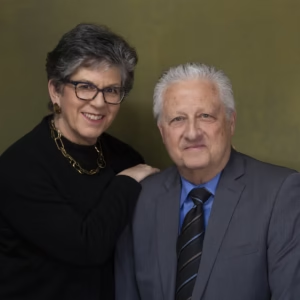
Deborah & David Cooper | Founders of Eli's Place
David and Deborah are suicide loss survivors and co-authors of Bridge over the River Why, a guide for parents who have lost children to suicide. Following the death of their son Eli, they became Founding Board Members of Eli’s Place. David, a retired business owner, has extensive corporate and non-profit leadership experience, including founding STUFF Canada to address homelessness and poverty, and has been recognized with national awards for social innovation and community impact. Deborah, a former Public Health Nurse and Nurse Educator with a focus on maternal and child health, has been a dedicated community volunteer and advocate for more than 50 years. Together, they continue to support others through grief work, advocacy, and their commitment to Eli’s Place.
- Deborah & David Cooper | Founders of Eli's Place

- Deborah & David Cooper | Founders of Eli's Place
- Deborah & David Cooper | Founders of Eli's Place