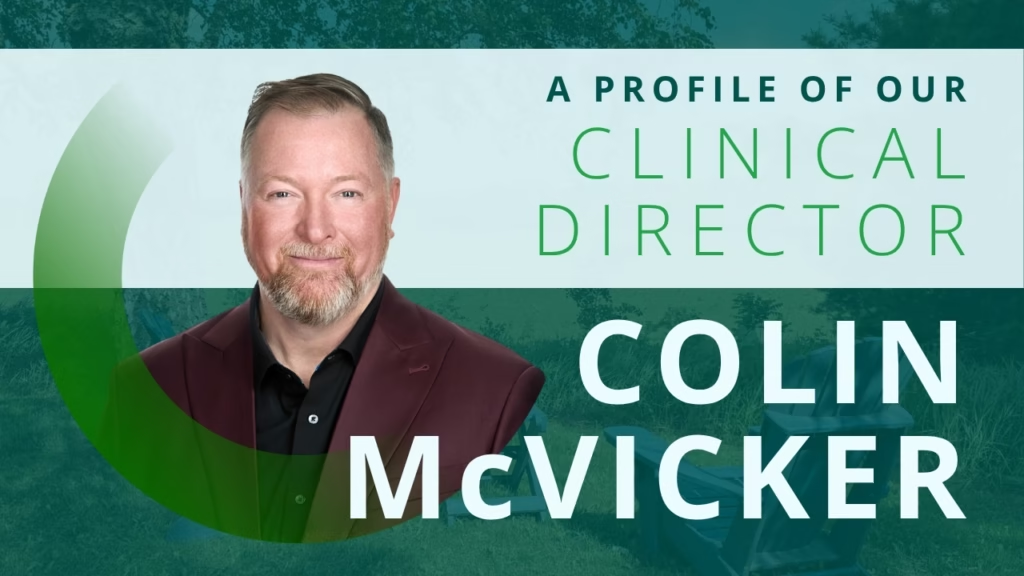
Colin McVicker lives in Rockwood, fifteen minutes from the land where Eli’s Place will open. He grew up on acreage, around growing things, and he’s direct about what that has to do with the job. “These are values that I want for my children,” he says. The property north of Guelph offers something he thinks most people in the mental health system never get offered. The chance, as he puts it, to remember what nature feels like.
He’s spent more than twenty years in that system. Most of it in rooms where recovery was discussed rather than practised.

He didn’t set out to work in mental health.
When he started university, he knew he wanted to work with people, and he knew he wanted it to mean something. Youth, specifically. He’d sat on youth committees in high school and in his township. Beyond that, nothing was settled.
“I say that the industry kind of chose me. I didn’t choose the industry.”
What followed was addictions counselling at his local college, then halfway houses in Windsor, then a job across the river that reorganized how he thought about the work.
Detroit taught him something no credential could.
At the Salvation Army’s therapeutic community in Detroit he was the lead addictions worker for more than five hundred men, most of them coming out of the prison system or off the street. It was the first time he’d been a minority. He’d come from what he describes without flinching as sheltered middle-class comfort into a place where nobody had that luxury.
It was also a therapeutic community run on very different terms from the one he’s building now. Heavy-handed, he says. Punitive. Go to your meetings or you’re out.
What he took from it wasn’t technique.
“I don’t care what your credentials are, how many years you’ve been working in this. You don’t own the recovery process. Every individual gets to own their recovery.”
The record behind that is longer and more varied than most clinical directors bring. Eight years as an addictions counsellor with Homewood Health’s Community Addiction Services, beginning in 2007. A year with the Canadian Mental Health Association Waterloo Wellington as a Service Resolution Facilitator, chairing interdisciplinary planning tables for people the system had failed to coordinate around and stewarding more than $2.5 million in funding allocations. Two terms as Program Director at Sanguen Health Centre, leading interdisciplinary teams delivering primary care, mental health, addictions treatment, outreach and harm reduction to people contending with homelessness and serious mental illness at the same time. Along the way he co-founded a virtual mental health service, and for the past six years he’s consulted to healthcare organizations and taught Healthcare Administration at Conestoga College.
He describes the benefit as gears. Engaging a fourteen-year-old isn’t engaging a family, and neither is engaging someone building their own recovery. Mostly, he says, it keeps him humble. There’s no one way to do this.
It also gave him a clear view of where the system stops. Acute crisis response is the thing Ontario does well, he argues, because that’s what it’s funded and trained for. Stabilize, stabilize, stabilize.
“Recovery isn’t stabilization,” he says. “Stabilization is a part of the recovery process.” What comes after is where the system thins out. Purpose, belonging, difficult conversations, the willingness to be vulnerable. He’s watched clinicians carry caseloads of over seventy people. “You’re just producing.”
He recognized the model before he applied for the job.
Friends sent him the posting for the Clinical Director role. He showed it to his family, who read it and told him what he already suspected.
“They said, that’s you. And I said, yeah, it is.”
He calls it a legacy project, and he means something specific by it. Another option in the Canadian mental health system for people who’ve already been stabilized and have nowhere to go next. As a clinician, what convinces him isn’t the setting but the mechanism.
“In a lot of residential or controlled outpatient settings, we do a lot of treatment planning around strategizing. We talk about theories, we talk about psychoeducational models. What we’re doing here is we’re immersed.”
That distinction runs deeper than it first appears. Talk therapy plans for a life. A working community requires one. Guests will disagree with each other, work alongside people they find difficult, handle equipment, have a falling out and repair it. He’s emphatic that this isn’t a design flaw.
He’s equally emphatic about what people get wrong first. The work is the piece nobody understands on first contact. Colleagues hear about it and assume it fills the day.
“It’s not busyness. It’s building purpose.” On a rainy Monday morning, out doing work therapy, there will be a story behind it, and a support behind it, and camaraderie behind it. That’s the treatment, not the scaffolding around it.
“The therapeutic community is the lead. And the clinical supports the therapeutic community. To me, that’s brilliant.”
What he’s building is a culture, not a document.
His first priorities are finalizing the Clinical Plan and hiring the clinical team, and he doesn’t treat these as separate tasks. The plan sets the heartbeat, he says. What’s acceptable, how guests are engaged, how staff hold each other. It reaches well past the clinicians into residence teams, work team leads, nursing and administration.
The values he names for that team are humility, creativity, flexibility and a clear-eyed sense of the team’s own limits. Asked what he’ll actually hire for, he returns to the first word without hesitation.
“Every guest has strengths, even though we don’t see them yet.” The job, as he frames it, isn’t leading people through a change process, which is what he’s done in every hospital and outpatient setting he’s worked in. It’s having the humility to be with someone in theirs.
“The Plan will include clinical protocols, staffing, risk management, documentation, all the things you have to get right. It will also include how to respond when someone struggles. Do we see challenging behaviour as something to suppress or as information that helps us understand what somebody needs?”
Which brings him to the day that matters most, the one where a guest walks in for the first time.
“My hope is that every guest gets to experience normalcy. Not a crisis-based response. They come into the space and they see people eating. They see people socializing. They see staff and guests having a conversation. I want guests to understand that we’re not asking them to come here to be a patient all day. We’re asking them to become part of something bigger.”
And on their last day? That they can look back at what the word community meant to them when they arrived, and what it means now. That they can give back. That they have the confidence to support someone else.
That they’re not isolated any more.

Eli’s Place Communications Team
Eli’s Place blogs are developed & written by the Eli’s Place Editorial Team — a collaboration between staff and volunteers committed to raising awareness about serious mental illness in Canada. We aim to inform, inspire, and engage with readers.
- Eli’s Place Communications Team
- Eli’s Place Communications Team
- Eli’s Place Communications Team

- Eli’s Place Communications Team